
You did everything they told you.
You built the to-do app. The weather app. The one that pulls from an API and lays it out in a nice clean grid. You pushed it all to GitHub. You wrote tidy READMEs. You pinned your six best repos to the top of your profile so they'd be the first thing anyone saw.
Then you sent it out.
Fifty times. A hundred. More than you want to admit.
And nothing came back. No callback. No take-home. Most of the time, not even a rejection. Just silence - which is somehow worse, because silence doesn't tell you what to fix.
So you assume the projects weren't good enough. You build another one. Cleaner. Fancier. Maybe dark mode this time.
Silence again.
Here is the part nobody wants to say to your face.
It was never that your projects were bad. It's that they stopped meaning anything.
Why the old portfolio worked (and why that's over)
For about fifteen years, the side project portfolio did one job, and it did it well. It was hard to fake.
Think about what a working app actually proved back then. To ship a weather app, you had to understand an API. You had to wrestle the data into shape. You had to deploy the thing so a stranger could open it without it falling over. Nobody walked into that by accident.
So when a hiring manager opened your portfolio, the building itself was the filter. The app wasn't the point. The fact that you could build the app was the point.
That filter is gone.
A machine can now build your weather app in the time it takes you to read this paragraph. It can clone a feed. It can stand up a dashboard, wire the API, write the README, and deploy it all for you - and all for the person next to you who couldn't actually engineer their way out of a wet paper bag.
Read that again, because it's the whole thing.
The skill your portfolio was built to prove is now the one skill everybody has for free.
The four-second tab

There is a hiring manager out there right now with two hundred portfolios open in two hundred browser tabs.
She is not reading them.
She is closing them.
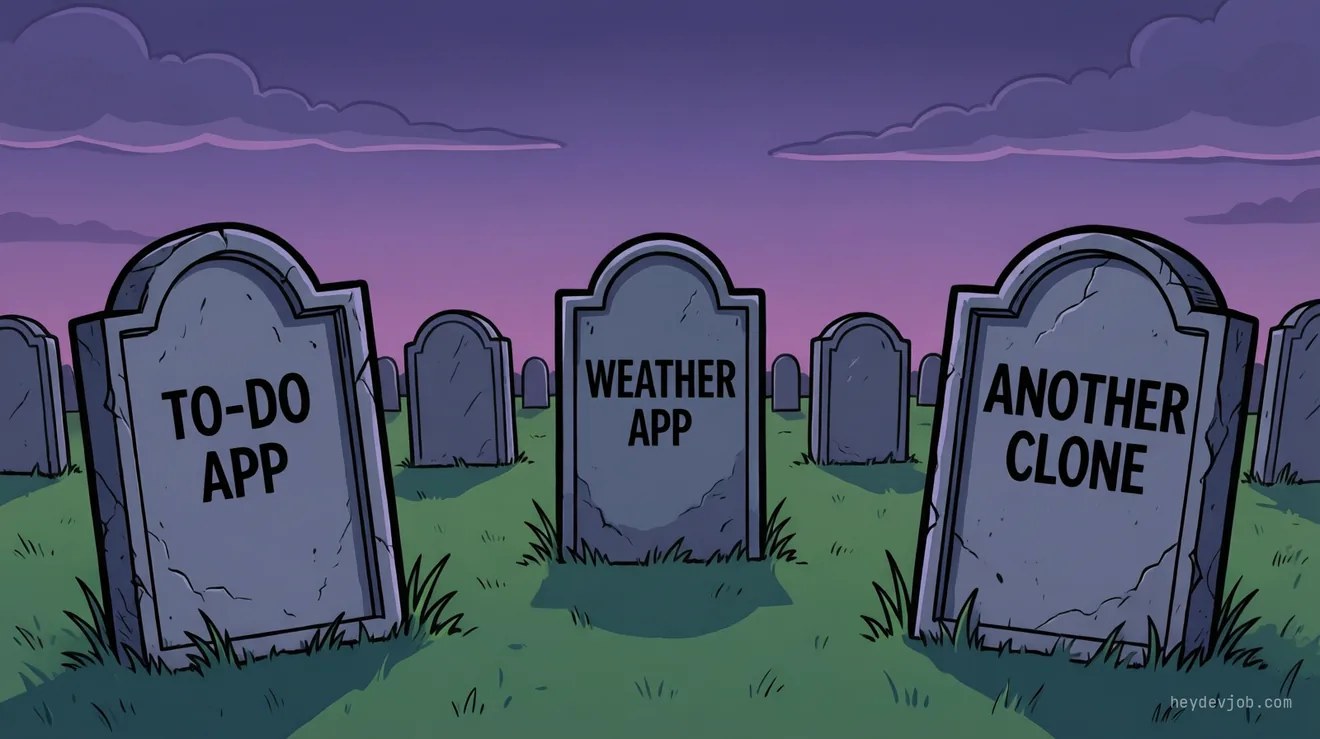
Four seconds each. Another to-do app. Close. Another dashboard. Close. Another clone of a thing that already exists, that took the applicant a weekend and an AI, that tells her absolutely nothing about whether this person can survive a Tuesday on her team. Close. Close. Close.
She isn't being lazy. She's being honest. A green-field demo used to be a signal. Now it's noise, because she genuinely cannot tell the difference between the person who built it and the person who prompted it.
And here's the cruel twist: the better your portfolio looks, the less it helps you. A flawless little app from a junior with no track record now reads as suspicious, not impressive. She's seen forty today.
The one thing AI is quietly terrible at
Here's what nobody is telling you, and it's the good news, so sit up.
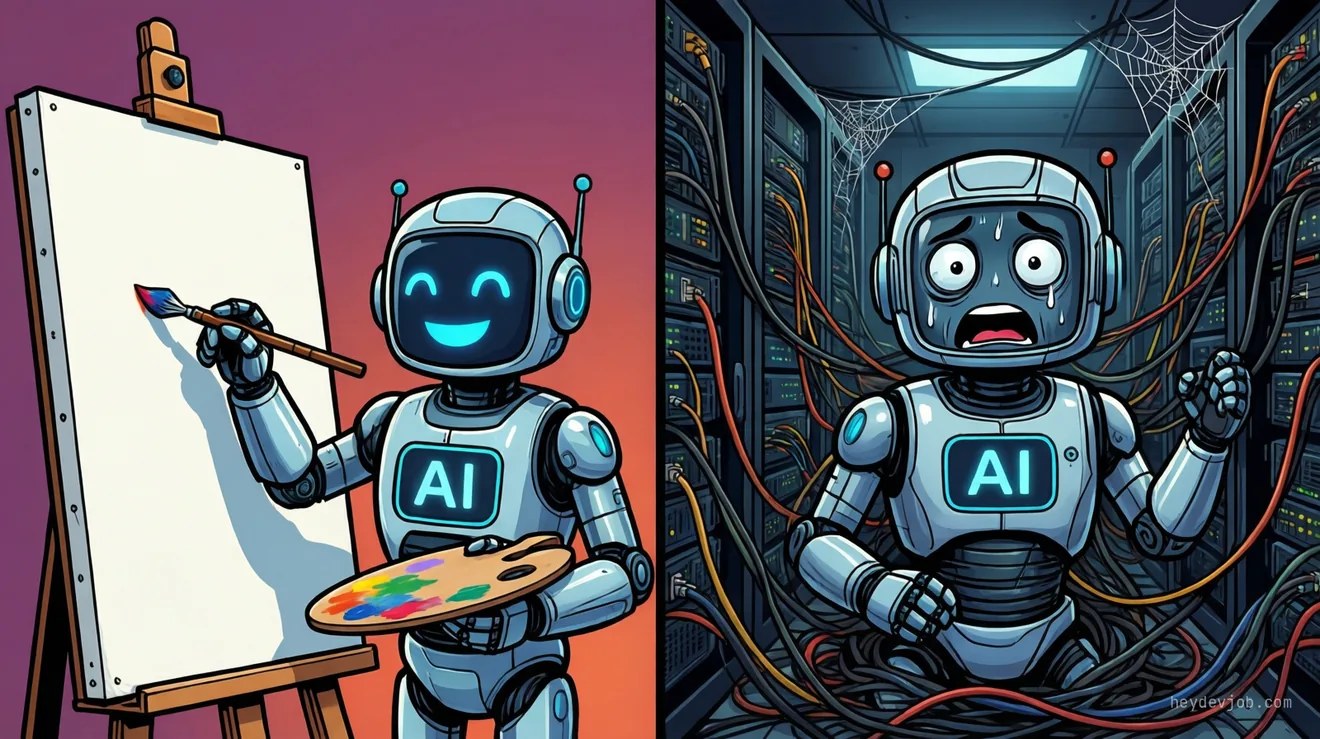
AI is brilliant at the blank page. It is completely lost in the haunted house.
Ask it to build something new and it'll hand you something shiny in seconds. But drop it into a live system that's already broken - broken in a way nobody documented, by someone who left the company two years ago, with logs that point you in the wrong direction and a config file that's lying to your face - and it flails. Because debugging a system you didn't build isn't about generating code. It's about forming a theory, testing it, being wrong, and forming a better one. It's detective work.
That haunted house? That's the actual job.
That's what the work looks like on day one of any real engineering role. Nobody hands you a blank file and says "build something cool." They hand you a system that's on fire and say "the checkout's down, figure it out."
And that is the one skill that got more valuable the day AI got good, not less. Everybody can ship now. Almost nobody can walk into someone else's mess and fix it.
So why are you still building things from scratch to prove yourself?
Build a portfolio of fixes, not clones
This is the whole reason we built HeyDevJob.
You open a ticket. Behind it is a real broken production system in a live cloud workspace - a real terminal, real services, a real thing that is genuinely, properly broken. Not a quiz. Not a puzzle with a known answer. A mess.
You investigate it the way you would on the job. You read the logs. You poke the services. You form a theory, you're wrong, you form a better one. And then you ship the fix.
Every fix you ship lands on a portfolio a hiring manager can open and click. Not a gallery of apps that look like everyone else's. Real work you can show - "here's a broken production system, and here's exactly how I tracked it down and fixed it."
That's the thing she'll actually slow down for. Because it's the thing she can't get from anyone with an AI and a weekend.
The pitch is simple: real production experience gets you hired. The kind AI can't fake - fixing real broken systems in live cloud workspaces, with a portfolio to prove you did it.
Pick your lane and start fixing real systems today - DevOps, backend engineering, security, data engineering, or AI/ML.
Stop proving you can build the thing AI builds for free.
Start proving you can fix the thing it can't.
Start your portfolio of real production fixes →
P.S. The next round of layoffs and the next wave of new grads are going to flood the market with the exact same six pinned repos you have. Identical apps, identical READMEs, all of it AI-assisted, all of it indistinguishable. The people who get the callbacks won't be the ones with the prettiest blank-page projects. They'll be the ones who can prove they've already walked into the haunted house and come out with the fix.